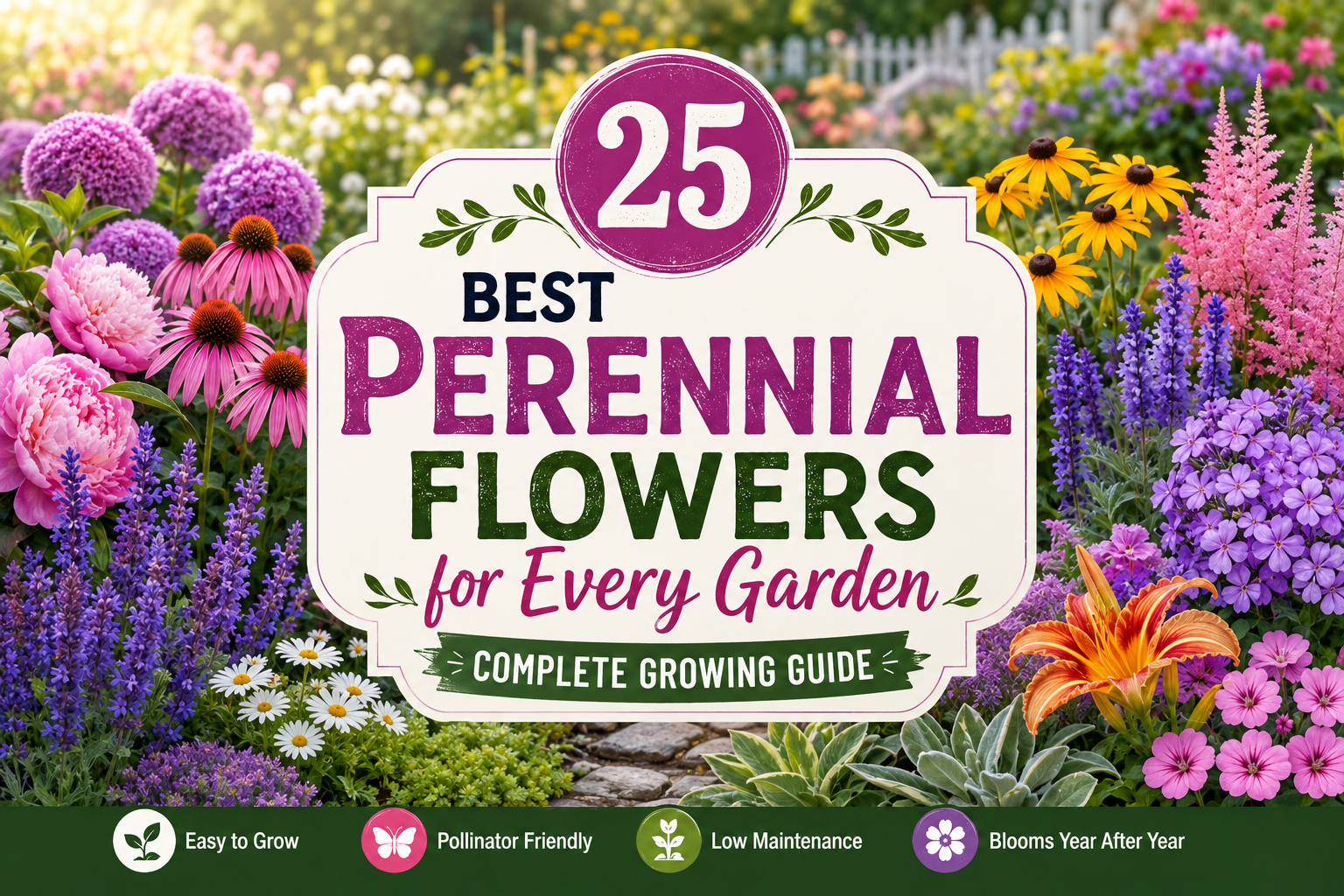
Perennial flowers are one of the best investments you can make for a beautiful, long-lasting garden. Unlike annuals that need to be replanted every year, Perennial Flowers return season after season, bringing reliable color, texture, and charm to your outdoor space. Once established, many perennials require very little maintenance, making them perfect for both beginner and experienced gardeners.
Whether you’re designing a colorful flower bed, attracting pollinators, or creating a cottage-style landscape, perennial flowers offer endless possibilities. From vibrant coneflowers and cheerful black-eyed Susans to elegant peonies and fragrant lavender, there’s a perennial suited to every garden style and climate. Many varieties also attract bees, butterflies, and hummingbirds, helping support local wildlife while enhancing your landscape.
In this complete guide, you’ll discover the 25 best Perennial Flowers for every garden, along with their growing requirements, care tips, bloom times, and ideal planting locations. You’ll also learn how to choose the right perennials, compare popular varieties, and keep your garden blooming beautifully year after year with minimal effort.
Why Choose Perennial Flowers?
Perennial flowers are a favorite among gardeners because they provide beauty year after year without needing to be replanted. Once their root systems are established, these plants often become stronger and produce even more blooms with each growing season.
Growing Perennial Flowers also saves time and money in the long run. Instead of buying new flowers every spring, you can enjoy reliable blooms from the same plants for many years.
Some perennials bloom for weeks, while others flower in different seasons, allowing you to create a garden that stays colorful from spring through fall.
Benefits of Growing Perennial Flowers
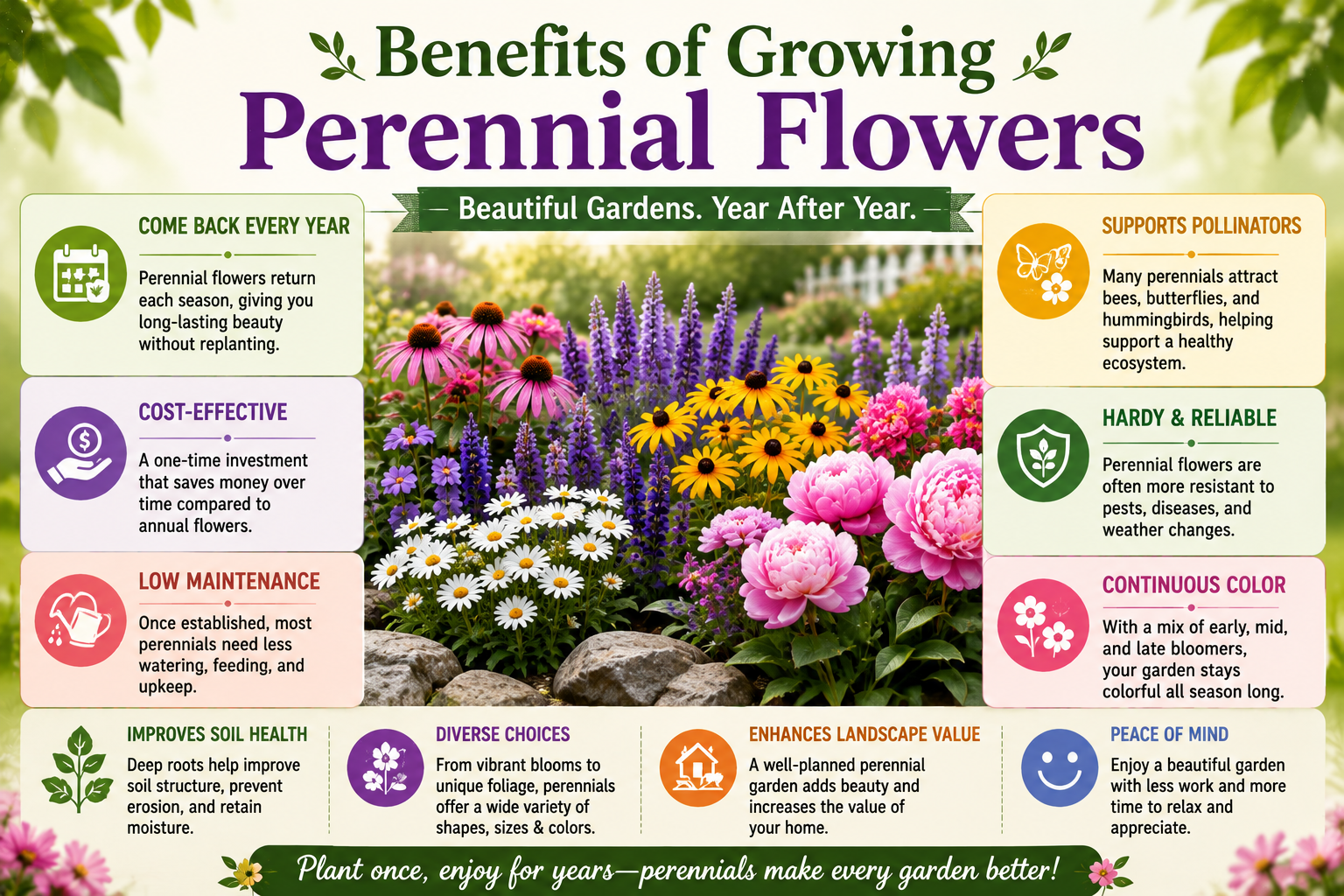
Adding perennial flowers to your garden offers several long-term advantages.
Long-Lasting Beauty
Most perennial flowers return every year, providing dependable blooms with minimal effort.
Lower Gardening Costs
Although the initial purchase may cost slightly more than annual flowers, perennials eliminate the need for yearly replacements.
Low Maintenance
Many perennial flowers become drought-tolerant after establishment and require less watering and fertilizing.
Supports Pollinators
Many popular perennial flowers attract:
- Butterflies
- Bees
- Hummingbirds
- Beneficial insects
These pollinators improve the health of your entire garden.
Improves Garden Design
Perennials create structure and consistent color in:
- Flower beds
- Garden borders
- Walkways
- Rock gardens
- Cottage gardens
- Backyard landscapes
How to Choose the Best Perennial Flowers
Before selecting plants, consider the growing conditions in your garden.
Choose perennial flowers based on:
- USDA hardiness zone
- Sunlight availability
- Soil drainage
- Water requirements
- Bloom season
- Mature plant size
- Flower color
- Pollinator friendliness
Matching plants to your garden conditions helps ensure healthy growth and continuous blooms.
Easy Perennial Flowers for Beginners
If you’re just getting started with gardening, choose hardy varieties that are easy to grow.
Best Beginner-Friendly Perennials
- Coneflower (Echinacea)
- Black-Eyed Susan
- Daylily
- Shasta Daisy
- Coreopsis
- Lavender
- Yarrow
- Bee Balm
These flowers are forgiving, adaptable, and require very little maintenance once established.
Perennial Flowers vs. Annual Flowers
| Feature | Perennial Flowers | Annual Flowers |
|---|---|---|
| Life Cycle | Return every year | Complete life cycle in one season |
| Replanting | Not required annually | Required every year |
| Maintenance | Low once established | Moderate |
| Initial Cost | Slightly higher | Usually lower |
| Long-Term Value | Excellent | Moderate |
| Examples | Peony, Lavender, Coneflower | Marigold, Petunia, Zinnia |
Best Growing Conditions for Perennial Flowers
Although different flowers have different needs, most Perennial Flowers thrive under similar conditions.
For the best results:
- Plant in well-draining soil.
- Provide 6–8 hours of sunlight for sun-loving varieties.
- Add compost before planting.
- Water regularly during the first growing season.
- Apply mulch to conserve moisture and suppress weeds.
Healthy soil and proper sunlight are the foundation of long-lasting perennial gardens.
25 Best Perennial Flowers for Every Garden
1. Coneflower (Echinacea)
Coneflowers are among the most popular Perennial Flowers thanks to their vibrant daisy-like blooms and exceptional drought tolerance. They bloom from early summer until fall and attract butterflies, bees, and songbirds, making them perfect for pollinator gardens.
Once established, coneflowers require very little maintenance and thrive in a variety of soil conditions.
Growing Tips
- Sunlight: Full sun
- Water: Moderate until established
- Bloom Season: Summer to early fall
- Best For: Pollinator gardens and borders
2. Black-Eyed Susan
Black-Eyed Susan is a cheerful perennial featuring bright golden-yellow petals surrounding dark centers. It blooms for several months and tolerates heat, drought, and poor soil.
These hardy flowers brighten flower beds while attracting butterflies throughout summer.
Growing Tips
- Sunlight: Full sun
- Water: Low to moderate
- Bloom Season: Mid-summer to fall
- Best For: Cottage gardens and borders
3. Lavender
Lavender is famous for its fragrant purple flower spikes and soothing aroma. Besides its ornamental beauty, it attracts pollinators while naturally repelling certain garden pests.
Its drought resistance makes it one of the easiest perennial flowers to maintain.
Growing Tips
- Sunlight: Full sun
- Water: Low
- Bloom Season: Late spring to summer
- Best For: Herb gardens, borders, and containers
4. Daylily
Daylilies produce trumpet-shaped flowers in a wide variety of vibrant colors. Although each bloom lasts only one day, the plant continuously produces new flowers for several weeks.
They tolerate different soil types and require very little care.
Growing Tips
- Sunlight: Full sun to partial shade
- Water: Moderate
- Bloom Season: Early to mid-summer
- Best For: Flower beds and walkways
5. Shasta Daisy
Shasta Daisies feature classic white petals with bright yellow centers. Their long-lasting blooms make excellent cut flowers while adding elegance to any garden.
These dependable perennials bloom generously with minimal maintenance.
Growing Tips
- Sunlight: Full sun
- Water: Moderate
- Bloom Season: Summer
- Best For: Borders and cutting gardens
6. Coreopsis (Tickseed)
Coreopsis produces cheerful yellow, orange, or pink flowers that bloom continuously for months. It thrives in hot weather and tolerates drought once established.
Deadheading faded flowers encourages even more blooms.
Growing Tips
- Sunlight: Full sun
- Water: Low
- Bloom Season: Early summer through fall
- Best For: Pollinator gardens and borders
7. Bee Balm
Bee Balm produces colorful tubular flowers that attract hummingbirds, butterflies, and bees throughout the growing season.
Its fragrant foliage and vibrant blooms make it a favorite choice for wildlife-friendly gardens.
Growing Tips
- Sunlight: Full sun to partial shade
- Water: Moderate
- Bloom Season: Mid to late summer
- Best For: Pollinator gardens
8. Yarrow
Yarrow is one of the toughest Perennial Flowers, producing flat clusters of tiny blooms in shades of yellow, white, pink, and red.
Its drought tolerance and fern-like foliage make it ideal for low-maintenance landscapes.
Growing Tips
Best Soil for Perennial Flowers
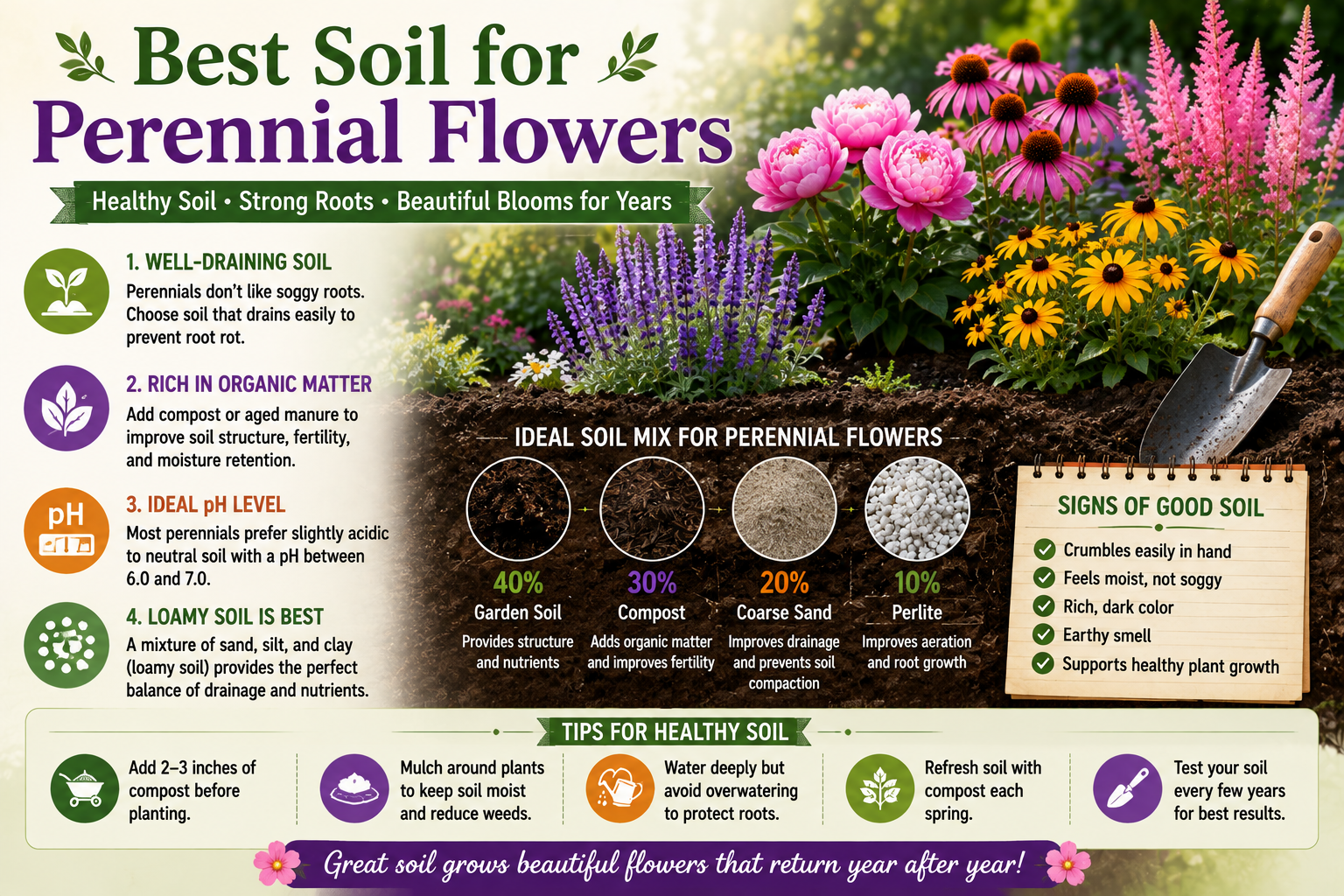
Healthy soil helps perennial flowers establish strong root systems that support years of reliable blooms.
For the best results:
- Choose well-draining soil.
- Add compost before planting.
- Avoid compacted or waterlogged soil.
- Maintain a soil pH between 6.0 and 7.0.
- Apply organic mulch to retain moisture and reduce weeds.
Improving the soil before planting reduces future maintenance and encourages healthier plants.
Watering Perennial Flowers
Proper watering is especially important during the first growing season while roots become established.
Best Watering Practices
- Water deeply once or twice a week.
- Allow the top layer of soil to dry slightly between watering.
- Water early in the morning.
- Avoid overhead watering whenever possible.
- Reduce watering once plants are well established.
- Increase watering during prolonged hot, dry weather.
Deep watering promotes stronger root growth and improves drought resistance.
Fertilizing Perennial Flowers
Unlike many annual flowers, most perennials don’t require frequent fertilizing.
Fertilizer Tips
- Mix compost into the soil before planting.
- Apply a balanced slow-release fertilizer in early spring.
- Avoid excessive nitrogen, which encourages leafy growth instead of flowers.
- Refresh mulch annually to improve soil quality.
Using too much fertilizer can actually reduce flowering in many perennial varieties.
Sunlight Requirements
Different perennial flowers have different sunlight needs, so choosing the right location is essential.
| Sunlight | Suitable Perennial Flowers |
|---|---|
| Full Sun (6–8 hours) | Coneflower, Lavender, Coreopsis, Yarrow, Shasta Daisy |
| Partial Sun (4–6 hours) | Daylily, Bee Balm, Black-Eyed Susan |
| Partial Shade | Some Daylily and Bee Balm varieties |
Providing the correct amount of sunlight helps plants produce healthier foliage and more abundant blooms.
Common Growing Problems and Solutions
Even hardy Perennial Flowers can occasionally face growing challenges. Fortunately, most problems are easy to solve with proper care.
| Problem | Possible Cause | Solution |
|---|---|---|
| Few blooms | Insufficient sunlight | Move plants to a sunnier location |
| Yellow leaves | Overwatering | Improve soil drainage and reduce watering |
| Weak growth | Poor soil fertility | Add compost or balanced fertilizer |
| Powdery mildew | Poor air circulation | Space plants properly and prune crowded growth |
| Wilting | Heat stress or underwatering | Water deeply during dry periods |
| Root rot | Waterlogged soil | Improve drainage before planting |
By identifying issues early and making small adjustments, you can keep your perennial garden healthy and blooming season after season.
9. Peony
Peonies are prized for their large, fragrant blooms that appear in late spring and early summer. These elegant Perennial Flowers can live for decades with proper care, making them a wonderful long-term addition to any garden.
Growing Tips
- Sunlight: Full sun
- Water: Moderate
- Bloom Season: Late spring to early summer
- Best For: Cottage gardens and borders
10. Salvia
Salvia produces tall spikes of purple, blue, pink, or red flowers that bloom for months. It attracts bees, butterflies, and hummingbirds while tolerating drought once established.
Growing Tips
- Sunlight: Full sun
- Water: Low to moderate
- Bloom Season: Late spring to fall
- Best For: Pollinator gardens
11. Astilbe
Astilbe thrives in partially shaded gardens where many flowering plants struggle. Its feathery flower plumes add texture and elegance to shaded landscapes.
Growing Tips
- Sunlight: Partial shade
- Water: Moderate to high
- Bloom Season: Summer
- Best For: Shade gardens
12. Hosta
Hostas are grown mainly for their attractive foliage, but they also produce delicate lavender or white flowers during summer. They perform exceptionally well in shady areas.
Growing Tips
- Sunlight: Partial to full shade
- Water: Moderate
- Bloom Season: Summer
- Best For: Shade borders
13. Russian Sage
Russian Sage produces airy lavender-blue flower spikes that bloom for months. Its silvery foliage adds beauty even when the plant isn’t flowering.
Growing Tips
- Sunlight: Full sun
- Water: Low
- Bloom Season: Summer through fall
- Best For: Dry landscapes
14. Blanket Flower (Gaillardia)
Blanket Flower produces vibrant red, orange, and yellow blooms that brighten gardens all summer. It performs well in poor soil and requires minimal maintenance.
Growing Tips
- Sunlight: Full sun
- Water: Low
- Bloom Season: Summer to fall
- Best For: Borders and pollinator gardens
15. Garden Phlox
Garden Phlox produces fragrant flower clusters in shades of pink, white, purple, and red. It creates a colorful display while attracting butterflies.
Growing Tips
- Sunlight: Full sun
- Water: Moderate
- Bloom Season: Mid to late summer
- Best For: Cottage gardens
16. Sedum (Stonecrop)
Sedum is a drought-tolerant perennial with succulent leaves and clusters of star-shaped flowers. It is excellent for rock gardens and low-water landscapes.
Growing Tips
- Sunlight: Full sun
- Water: Low
- Bloom Season: Late summer to fall
- Best For: Rock gardens
17. Columbine
Columbine features unique bell-shaped flowers in a wide range of colors. It grows well in partial shade and self-seeds easily.
Growing Tips
- Sunlight: Partial sun
- Water: Moderate
- Bloom Season: Spring to early summer
- Best For: Woodland gardens
18. Hellebore
Known as the Christmas or Lenten Rose, Hellebores bloom earlier than many other perennials and tolerate deep shade.
Growing Tips
- Sunlight: Partial to full shade
- Water: Moderate
- Bloom Season: Late winter to early spring
- Best For: Shade gardens
19. Veronica (Speedwell)
Veronica produces upright flower spikes in blue, pink, white, and purple shades. It provides long-lasting color throughout summer.
Growing Tips
- Sunlight: Full sun
- Water: Moderate
- Bloom Season: Summer
- Best For: Borders
20. Catmint (Nepeta)
Catmint is a fragrant perennial that produces soft lavender-blue flowers for months. It is highly drought-tolerant and attracts pollinators.
Growing Tips
- Sunlight: Full sun
- Water: Low
- Bloom Season: Late spring to fall
- Best For: Walkways and borders
21. Balloon Flower
Balloon Flower gets its name from its balloon-shaped buds that open into star-shaped blooms during summer.
Growing Tips
- Sunlight: Full sun to partial shade
- Water: Moderate
- Bloom Season: Summer
- Best For: Flower beds
22. Lupine
Lupines produce tall spikes covered with colorful pea-like flowers that make dramatic focal points in spring gardens.
Growing Tips
- Sunlight: Full sun
- Water: Moderate
- Bloom Season: Late spring
- Best For: Cottage gardens
23. Japanese Anemone
Japanese Anemones provide elegant blooms during late summer and fall, extending the flowering season when many other plants have finished.
Growing Tips
- Sunlight: Partial shade
- Water: Moderate
- Bloom Season: Late summer to fall
- Best For: Woodland gardens
24. Coral Bells (Heuchera)
Coral Bells are loved for their colorful foliage and delicate flower spikes. They perform well in both containers and garden beds.
Growing Tips
- Sunlight: Partial shade
- Water: Moderate
- Bloom Season: Late spring
- Best For: Borders and containers
25. Hardy Geranium (Cranesbill)
Hardy Geranium produces abundant blooms while forming attractive ground cover. It spreads gradually and requires very little maintenance.
Growing Tips
- Sunlight: Full sun to partial shade
- Water: Moderate
- Bloom Season: Late spring through summer
- Best For: Ground cover and borders
How to Care for Perennial Flowers
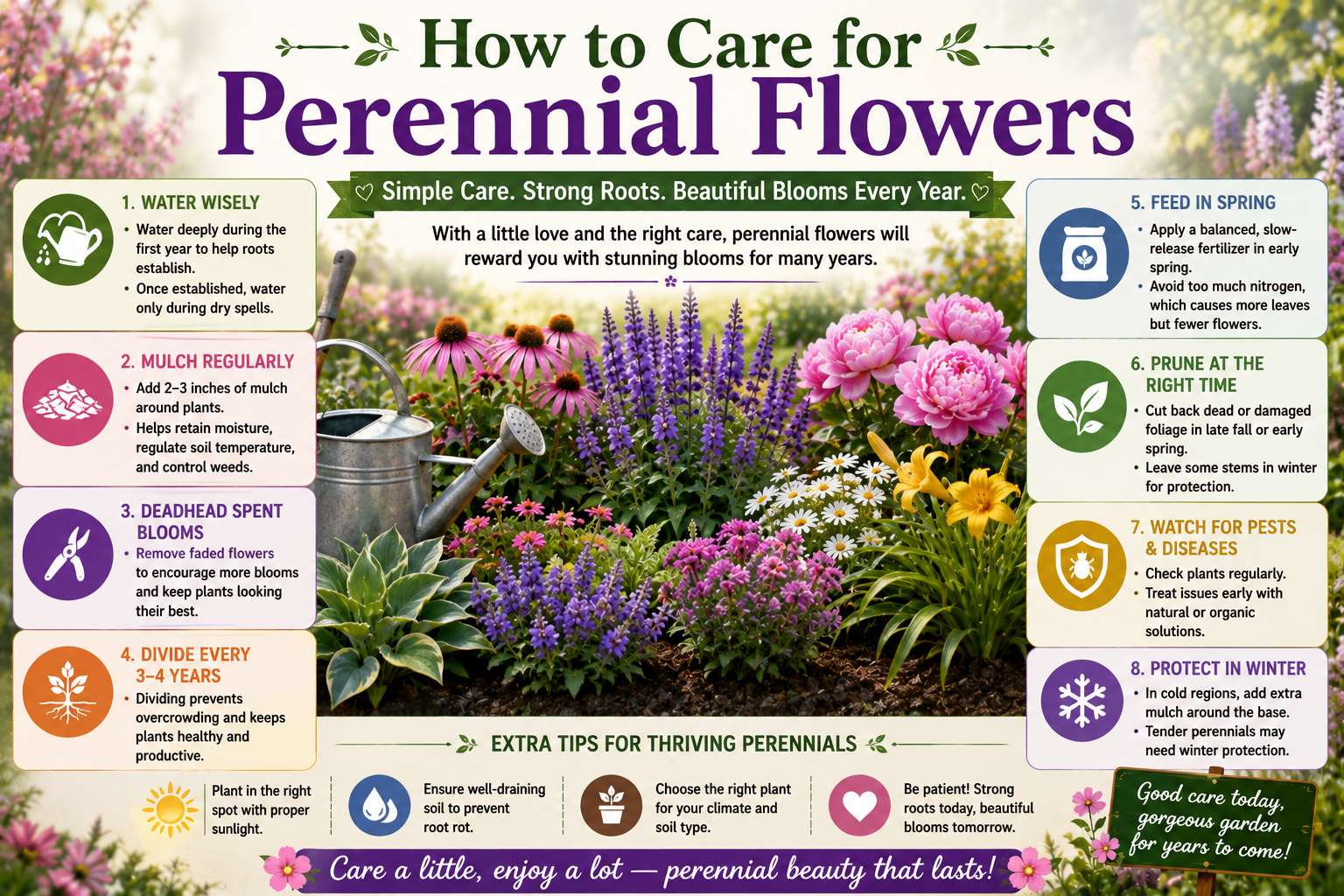
Proper care helps Perennial Flowers stay healthy and bloom beautifully for many years.
Essential Care Tips
- Water regularly during the first year.
- Apply mulch to conserve soil moisture.
- Remove faded flowers to encourage additional blooms.
- Divide overcrowded plants every few years.
- Fertilize lightly in spring.
- Prune dead foliage in late fall or early spring.
- Monitor for pests and diseases.
Common Mistakes to Avoid
Avoid these common gardening mistakes to keep your perennial flowers thriving.
Mistakes to Watch For
- Planting in the wrong sunlight conditions.
- Overwatering established plants.
- Ignoring soil drainage.
- Overcrowding flower beds.
- Applying too much fertilizer.
- Forgetting to divide mature plants.
- Choosing varieties unsuitable for your climate.
Seasonal Care Tips
Spring
- Clean flower beds.
- Apply compost.
- Plant new perennials.
- Divide overcrowded plants.
Summer
- Water during dry periods.
- Deadhead spent flowers.
- Watch for pests.
- Add mulch if needed.
Fall
- Remove diseased foliage.
- Plant fall-blooming perennials.
- Water before the first frost.
Winter
- Protect tender plants with mulch.
- Avoid disturbing dormant roots.
- Plan next season’s flower garden.
Conclusion
Growing Perennial Flowers is one of the easiest ways to create a colorful, long-lasting garden that returns year after year. From timeless favorites like peonies and lavender to pollinator-friendly coneflowers and bee balm, these plants provide beauty with relatively little maintenance.
By selecting flowers that suit your climate, preparing healthy soil, and following basic watering and care practices, you can enjoy continuous blooms across multiple seasons. Mixing early, mid, and late-blooming varieties ensures your garden remains vibrant from spring through fall while supporting bees, butterflies, and hummingbirds.
Whether you’re starting your first flower bed or expanding an established landscape, these 25 perennial flowers will help you create a stunning garden you’ll enjoy for years to come.
Frequently Asked Questions (FAQs)
1. What are perennial flowers?
Perennial flowers are plants that live for more than two years and return each growing season from their established root systems.
2. Which perennial flowers bloom the longest?
Coneflowers, Coreopsis, Salvia, Catmint, and Blanket Flowers are among the longest-blooming perennial flowers.
3. Are perennial flowers easy to grow?
Yes. Most perennial flowers are beginner-friendly and require minimal maintenance once established.
4. When is the best time to plant perennial flowers?
Spring and early fall are the best times to plant most perennial flowers because temperatures are cooler and roots have time to establish.
5. Do perennial flowers need fertilizer every year?
Most only need compost or a balanced slow-release fertilizer once each spring.
6. Which perennial flowers attract butterflies?
Coneflowers, Bee Balm, Salvia, Lavender, Garden Phlox, and Yarrow are excellent choices for attracting butterflies and other pollinators.
7. Can perennial flowers grow in containers?
Yes. Many varieties, including Coral Bells, Lavender, Hosta, Hardy Geranium, and Daylilies, grow well in large containers with proper drainage.
You can also check out article 15 Low-Maintenance Flowers That Bloom All Summer