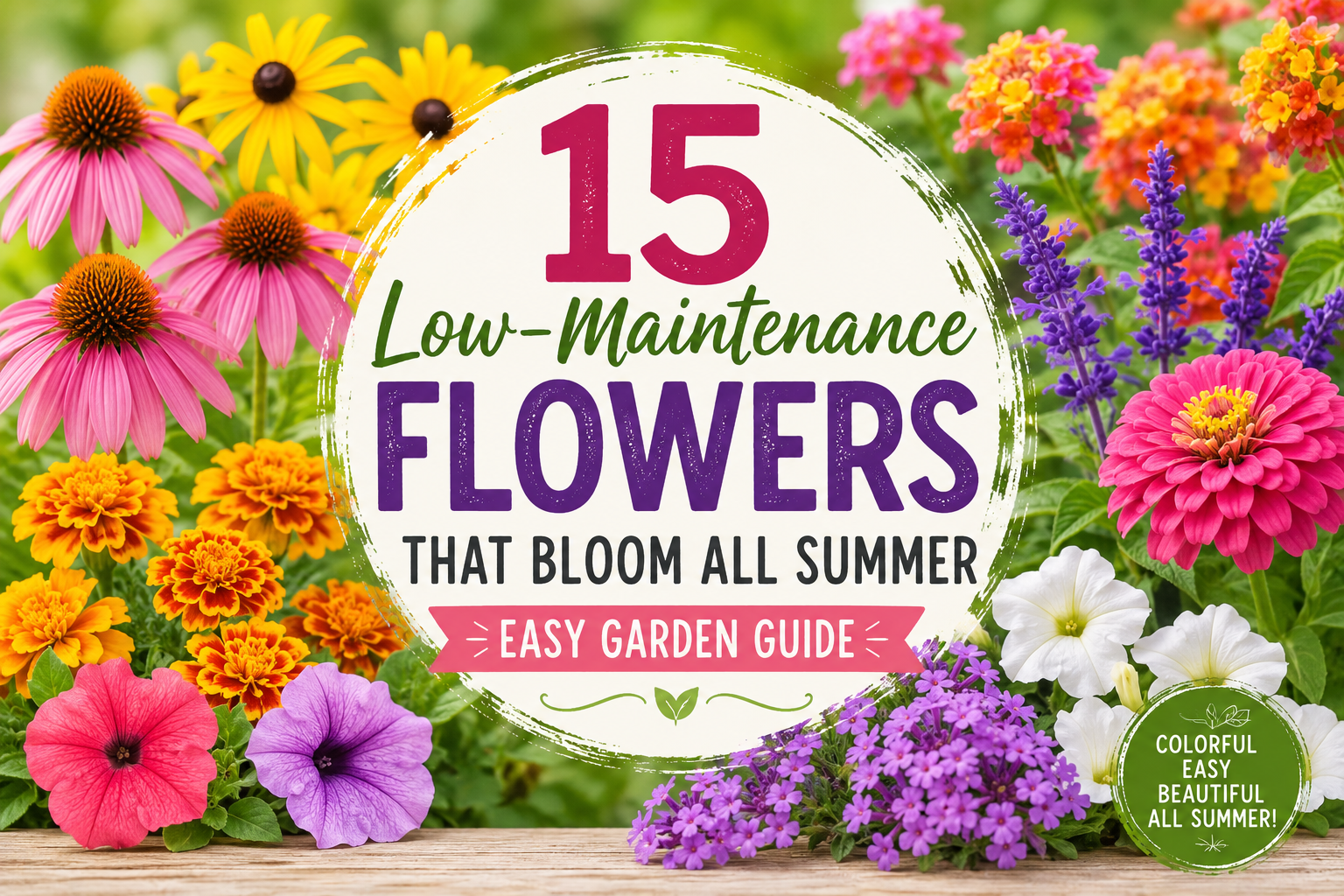
If you love colorful gardens but don’t have time for constant care, choosing Low-Maintenance Flowers is the perfect solution. These easy-to-grow flowers provide vibrant blooms throughout the summer while requiring minimal watering, pruning, and fertilizing. Whether you’re a beginner or an experienced gardener, planting hardy flowering plants can help you enjoy a beautiful landscape without spending hours maintaining it.
Many low-maintenance flowers are drought-tolerant, resistant to common pests, and capable of thriving in a variety of soil conditions. As a result, they are ideal for busy homeowners, small backyard gardens, containers, borders, and flower beds. Additionally, many of these flowers attract bees, butterflies, and other pollinators, making your garden healthier and more lively.
In this guide, you’ll discover 15 of the best Low-Maintenance Flowers that bloom all summer, along with their growing requirements, care tips, and benefits. You’ll also learn how to choose the right flowers for your garden, compare annuals and perennials, and keep your plants blooming from late spring until the first frost.
Why Choose Low-Maintenance Flowers?
Many gardeners assume beautiful flower beds require daily attention. Fortunately, that’s not true. Many flowering plants naturally thrive with very little care while producing colorful blooms for months.
Choosing Low-Maintenance Flowers offers several advantages:
- Save time on garden maintenance.
- Reduce watering and fertilizing.
- Lower gardening costs.
- Enjoy continuous summer blooms.
- Attract beneficial pollinators.
- Improve your home’s curb appeal.
- Grow successfully even as a beginner.
Because these flowers require less effort, you can spend more time enjoying your garden instead of constantly maintaining it.
Benefits of Growing Low-Maintenance Flowers
Planting easy-care flowers provides more than just beautiful blooms. They also improve your outdoor space and simplify gardening.
Some key benefits include:
Saves Time
Busy schedules often make gardening difficult. Low-maintenance flowers continue blooming with minimal care.
Conserves Water
Many varieties tolerate drought once established, making them suitable for regions with hot summers.
Reduces Gardening Costs
Since these flowers need fewer fertilizers, pesticides, and replacements, they are budget-friendly over time.
Supports Pollinators
Many flowers attract:
- Bees
- Butterflies
- Hummingbirds
- Beneficial insects
These visitors help pollinate your garden and support local ecosystems.
Brightens Outdoor Spaces
Long-lasting blooms keep flower beds, walkways, patios, and containers colorful throughout the growing season.
How to Choose the Best Low-Maintenance Flowers
Before selecting flowers, consider your growing conditions.
Choose flowers based on:
- Your local climate
- Sunlight availability
- Soil type
- Water requirements
- Garden size
- Bloom duration
- Plant height
Matching flowers to your environment improves growth and reduces maintenance.
Easy Low-Maintenance Flowers for Beginners
If you’re new to gardening, start with flowers that are known for their reliability.
Best Beginner-Friendly Choices
- Marigolds
- Zinnias
- Cosmos
- Black-Eyed Susan
- Coneflowers
- Moss Rose (Portulaca)
- Coreopsis
- Verbena
These flowers germinate easily, grow quickly, and continue blooming for months with little attention.
Annual vs. Perennial Low-Maintenance Flowers
| Feature | Annual Flowers | Perennial Flowers |
|---|---|---|
| Life Cycle | One growing season | Return every year |
| Bloom Time | Long continuous blooms | Bloom season varies |
| Replanting | Required each year | Usually unnecessary |
| Maintenance | Low | Very low once established |
| Cost Over Time | Higher | More economical |
| Examples | Marigold, Zinnia, Cosmos | Coneflower, Coreopsis, Black-Eyed Susan |
Best Growing Conditions
Most Low-Maintenance Flowers perform best when they receive:
- 6–8 hours of sunlight
- Well-draining soil
- Moderate watering
- Good air circulation
Adding compost before planting helps improve soil fertility while encouraging healthier blooms.
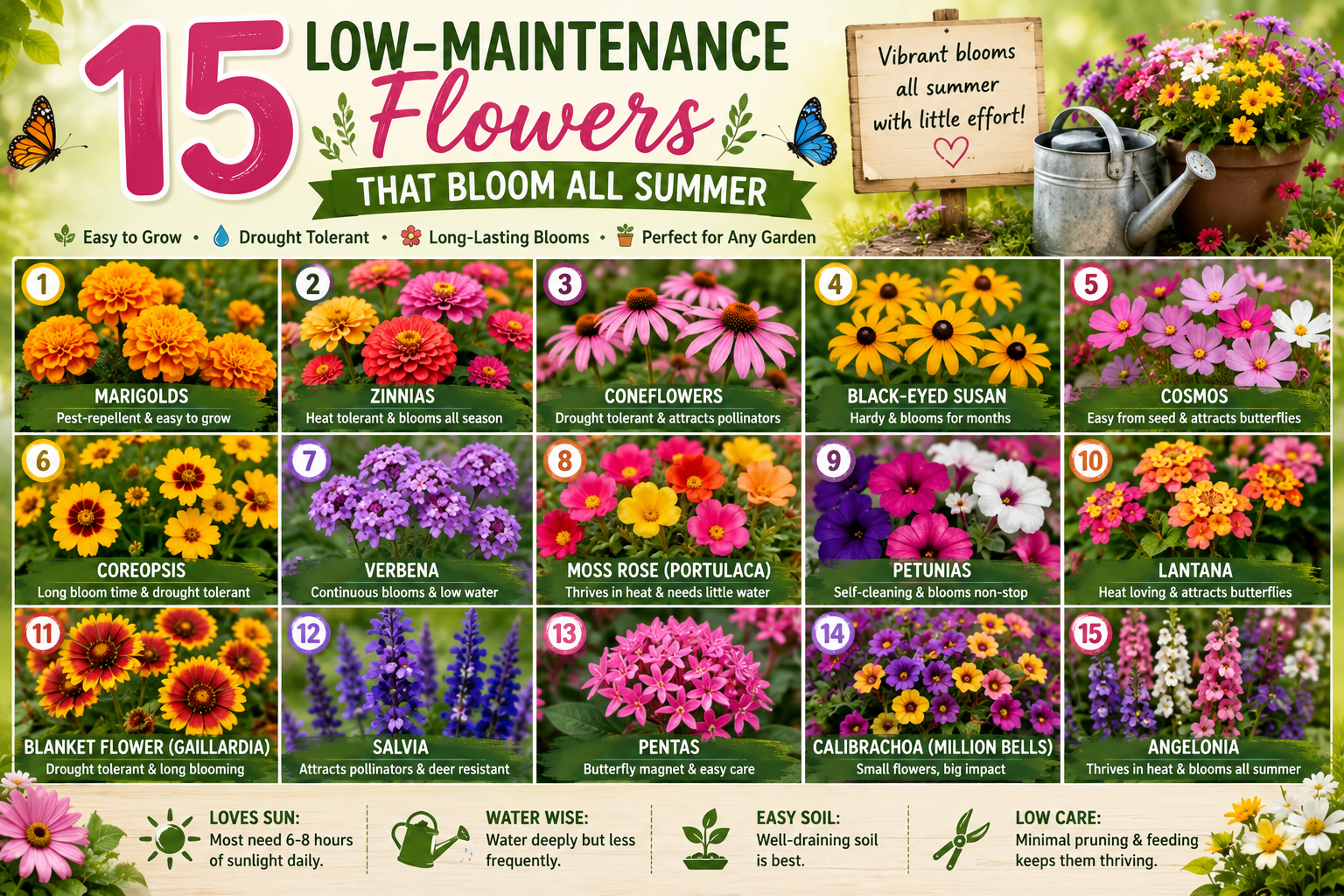
15 Low-Maintenance Flowers That Bloom All Summer
1. Marigolds
Marigolds are among the easiest Low-Maintenance Flowers you can grow. Their bright yellow, orange, and golden blooms add cheerful color to gardens from late spring until the first frost. Besides their beauty, marigolds naturally repel several common garden pests, making them an excellent companion plant for vegetables and herbs.
These flowers grow quickly from seeds or nursery plants and adapt well to flower beds, borders, and containers. Deadheading spent blooms encourages even more flowers throughout summer.
Growing Tips
- Sunlight: Full sun
- Water: Moderate
- Bloom Season: Late spring to fall
- Best For: Borders, containers, vegetable gardens
2. Zinnias
Zinnias are colorful annual flowers that bloom continuously with very little effort. Available in nearly every color except true blue, they create eye-catching flower beds while attracting butterflies and other beneficial pollinators.
They tolerate heat extremely well and continue flowering even during hot summer weather. Removing faded flowers helps produce fresh blooms for months.
Growing Tips
- Sunlight: Full sun
- Water: Moderate
- Bloom Season: Summer to frost
- Best For: Cutting gardens and borders
3. Coneflowers (Echinacea)
Coneflowers are hardy perennials known for their large daisy-like flowers with raised centers. Once established, they require very little watering and can tolerate periods of drought.
These flowers also attract bees, butterflies, and birds, making them an excellent choice for wildlife-friendly gardens.
Growing Tips
- Sunlight: Full sun
- Water: Low after establishment
- Bloom Season: Early summer to fall
- Best For: Pollinator gardens
4. Black-Eyed Susan
Black-Eyed Susan is a reliable perennial that produces cheerful golden-yellow flowers with dark brown centers. It thrives in poor soil and hot weather while requiring minimal care.
Because of its long blooming period, it’s a favorite choice for cottage gardens and natural landscapes.
Growing Tips
- Sunlight: Full sun
- Water: Low to moderate
- Bloom Season: Mid-summer to fall
- Best For: Large flower beds
5. Cosmos
Cosmos produce delicate, daisy-like flowers that bloom continuously through summer. Their tall stems sway beautifully in the breeze and attract butterflies in large numbers.
These flowers actually bloom better when grown in average soil rather than overly fertile soil.
Growing Tips
- Sunlight: Full sun
- Water: Low
- Bloom Season: Summer until frost
- Best For: Cottage gardens
6. Coreopsis
Coreopsis, often called Tickseed, produces bright yellow blooms that last for months. It tolerates drought, poor soil, and high temperatures without losing its vibrant appearance.
It is one of the longest-blooming perennials available.
Growing Tips
- Sunlight: Full sun
- Water: Low
- Bloom Season: Early summer through fall
- Best For: Borders and pollinator gardens
7. Verbena
Verbena forms clusters of colorful flowers that bloom continuously throughout summer. It spreads nicely across garden beds and hanging baskets while attracting butterflies.
Its drought tolerance makes it ideal for warm climates.
Growing Tips
- Sunlight: Full sun
- Water: Moderate
- Bloom Season: Late spring to frost
- Best For: Hanging baskets and containers
8. Moss Rose (Portulaca)
Moss Rose thrives in hot, dry conditions where many other flowers struggle. Its succulent leaves store moisture, allowing it to survive with very little watering.
The vibrant flowers open during sunny days and come in shades of pink, red, orange, yellow, and white.
Growing Tips
- Sunlight: Full sun
- Water: Very low
- Bloom Season: Summer to early fall
- Best For: Rock gardens and containers
Best Soil for Low-Maintenance Flowers
Healthy soil is the foundation of long-lasting blooms. Fortunately, most Low-Maintenance Flowers don’t require rich soil to thrive.
For the best results:
- Use well-draining soil.
- Mix compost before planting.
- Avoid heavy clay soil whenever possible.
- Maintain a soil pH between 6.0 and 7.0.
- Add organic mulch to retain moisture and suppress weeds.
Well-prepared soil encourages stronger roots and healthier plants while reducing maintenance.
Watering Tips
Although these flowers are easy to care for, proper watering helps them bloom longer.
Best Watering Practices
- Water deeply rather than frequently.
- Allow the top inch of soil to dry between watering.
- Water early in the morning.
- Avoid wetting the leaves.
- Reduce watering after plants become established.
- Increase watering during extended heat waves.
Deep watering encourages roots to grow deeper into the soil, making plants more drought-resistant.
Fertilizer Requirements
Unlike high-maintenance flowers, these plants usually need very little fertilizer.
Fertilizing Tips
- Apply compost before planting.
- Use a balanced slow-release fertilizer once during the growing season.
- Avoid excessive nitrogen fertilizers, as they encourage leaf growth instead of flowers.
- Feed container plants more often because nutrients wash out quickly.
A little fertilizer goes a long way for healthy blooms.
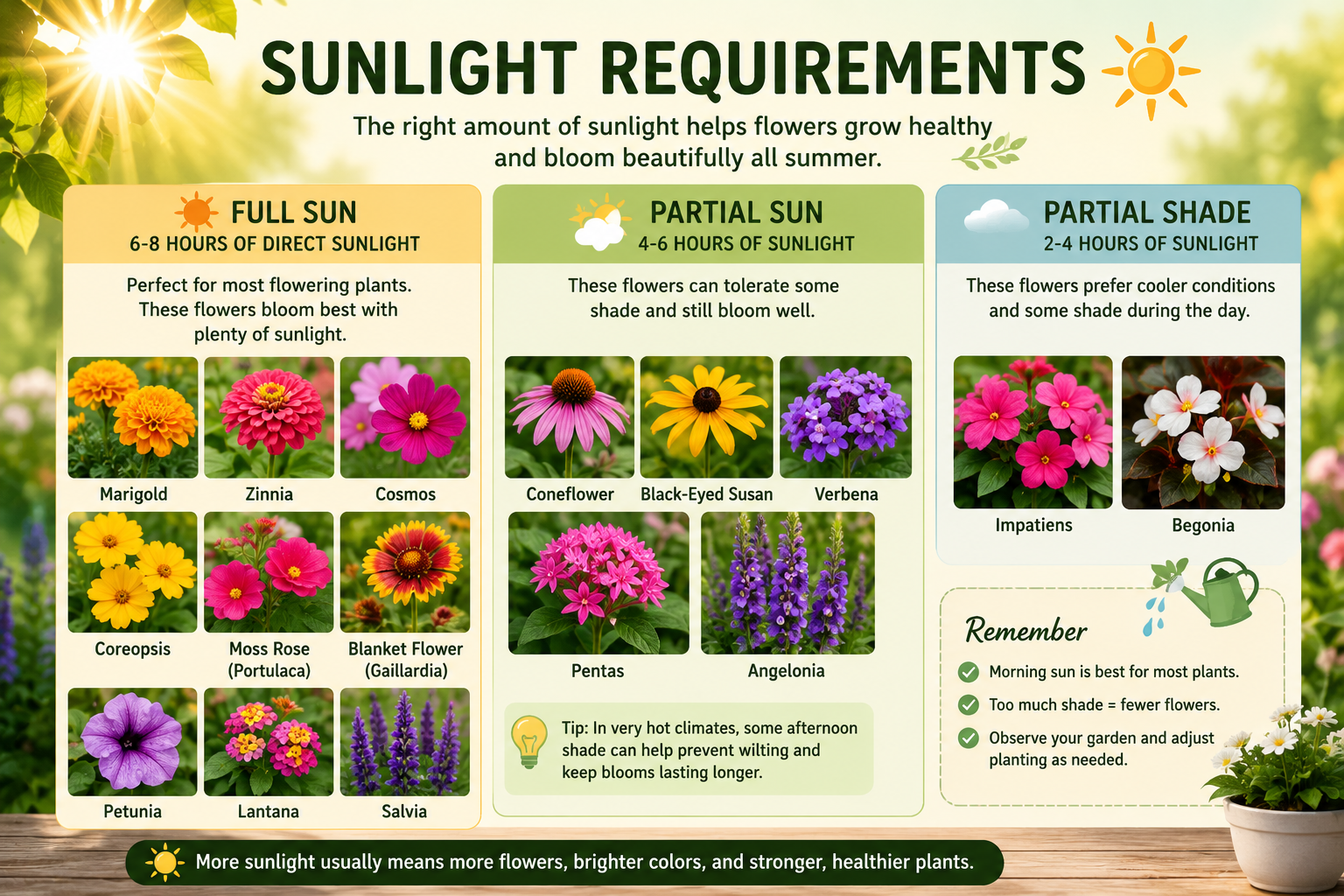
Sunlight Requirements
Most Low-Maintenance Flowers bloom best in full sunlight.
Light Requirements
| Sunlight | Suitable Flowers |
|---|---|
| Full Sun (6–8 hours) | Marigold, Zinnia, Cosmos, Coreopsis, Moss Rose |
| Partial Sun (4–6 hours) | Verbena, Coneflower, Black-Eyed Susan |
| Partial Shade | Some Verbena varieties |
Choosing flowers based on available sunlight helps ensure continuous blooms throughout summer.
Common Growing Problems and Solutions
Even easy-care flowers may experience occasional problems. Fortunately, most issues are simple to fix.
| Problem | Possible Cause | Solution |
|---|---|---|
| Few flowers | Insufficient sunlight | Move plants to a sunnier location |
| Yellow leaves | Overwatering | Allow soil to dry before watering |
| Weak stems | Too much fertilizer | Reduce nitrogen-rich fertilizers |
| Powdery mildew | Poor air circulation | Space plants properly |
| Wilting | Heat stress or underwatering | Water deeply during hot weather |
| Slow growth | Poor soil | Add compost or organic matter |
By identifying problems early, you can keep your flowers healthy and blooming throughout the season.
9. Petunias
Petunias are among the most popular Low-Maintenance Flowers because they produce abundant blooms from late spring until the first frost. Available in a wide range of colors, they brighten flower beds, hanging baskets, and containers with very little effort.
Modern petunia varieties are more heat-tolerant and self-cleaning, reducing the need for frequent deadheading.
Growing Tips
- Sunlight: Full sun
- Water: Moderate
- Bloom Season: Late spring to frost
- Best For: Hanging baskets, containers, borders
10. Lantana
Lantana is a heat-loving flowering plant that thrives in hot, sunny conditions. It produces clusters of colorful blooms that attract butterflies and hummingbirds throughout the summer.
Once established, lantana requires very little watering and performs exceptionally well during drought.
Growing Tips
- Sunlight: Full sun
- Water: Low
- Bloom Season: Spring through fall
- Best For: Hot climates and pollinator gardens
11. Blanket Flower (Gaillardia)
Blanket flowers produce bold red, orange, and yellow blooms that resemble miniature sunflowers. These drought-tolerant perennials bloom continuously and tolerate poor soil remarkably well.
Their long flowering season makes them ideal for colorful garden borders.
Growing Tips
- Sunlight: Full sun
- Water: Low
- Bloom Season: Early summer to fall
- Best For: Cottage gardens and borders
12. Salvia
Salvia adds height and vibrant color to flower gardens while attracting bees, butterflies, and hummingbirds. It blooms repeatedly throughout summer with minimal maintenance.
Many varieties are highly resistant to drought and deer.
Growing Tips
- Sunlight: Full sun
- Water: Moderate
- Bloom Season: Late spring through fall
- Best For: Pollinator gardens
13. Pentas
Pentas produce star-shaped flower clusters in shades of pink, red, white, and purple. These flowers thrive in warm climates and bloom continuously with basic care.
Because they attract butterflies throughout the season, they are an excellent addition to wildlife-friendly gardens.
Growing Tips
- Sunlight: Full sun to partial shade
- Water: Moderate
- Bloom Season: Summer to frost
- Best For: Containers and flower beds
14. Calibrachoa (Million Bells)
Often called Million Bells, Calibrachoa produces hundreds of small petunia-like flowers throughout the growing season. It spreads beautifully from containers and hanging baskets without requiring much maintenance.
Many newer varieties are self-cleaning, making them even easier to grow.
Growing Tips
- Sunlight: Full sun
- Water: Moderate
- Bloom Season: Spring through fall
- Best For: Hanging baskets and containers
15. Angelonia
Angelonia, also known as Summer Snapdragon, thrives in hot weather and continues blooming without frequent deadheading. Its upright flower spikes add elegance to borders and mixed flower beds.
It tolerates heat and humidity extremely well, making it perfect for long summer displays.
Growing Tips
- Sunlight: Full sun
- Water: Moderate
- Bloom Season: Summer until frost
- Best For: Borders and containers
How to Care for Low-Maintenance Flowers
Although these flowers require minimal attention, a few simple care practices will keep them blooming all season.
Essential Care Tips
- Water deeply during extended dry periods.
- Apply a layer of mulch to conserve moisture.
- Remove faded flowers when needed.
- Pull weeds regularly to reduce competition.
- Fertilize lightly once or twice during the growing season.
- Inspect plants occasionally for pests or diseases.
- Prune damaged stems to encourage healthy new growth.
Following these simple steps will help your garden remain colorful from early summer until fall.
Common Mistakes to Avoid
Even easy-to-grow flowers can struggle if basic gardening practices are overlooked.
Avoid These Common Mistakes
- Planting in too much shade.
- Overwatering the soil.
- Using heavy clay soil without improving drainage.
- Applying excessive fertilizer.
- Planting flowers too close together.
- Ignoring weeds around young plants.
- Choosing flowers that aren’t suitable for your climate.
Avoiding these mistakes helps your Low-Maintenance Flowers stay healthy and bloom for a longer period.
Seasonal Tips for Continuous Summer Blooms
Each season brings different gardening needs. A little seasonal care can make a big difference.
Spring
- Prepare the soil with compost.
- Plant seeds or young plants after the last frost.
- Apply mulch to retain moisture.
Summer
- Water deeply during heat waves.
- Deadhead flowers when necessary.
- Monitor for pests and diseases.
Fall
- Remove spent annual plants.
- Divide overcrowded perennials.
- Add compost to enrich the soil for next season.
Winter
- Protect tender perennials with mulch.
- Clean and store gardening tools.
- Plan next year’s flower garden.
Seasonal maintenance keeps your garden productive year after year.
Conclusion
Growing Low-Maintenance Flowers is one of the easiest ways to enjoy a vibrant garden all summer without spending hours on upkeep. Whether you choose cheerful marigolds, colorful zinnias, drought-tolerant lantanas, or long-blooming coneflowers, these flowers provide continuous beauty with minimal effort.
By selecting plants that suit your climate, preparing well-draining soil, providing enough sunlight, and following simple watering practices, you can create a colorful landscape that attracts butterflies, bees, and hummingbirds throughout the season. Even beginner gardeners can achieve impressive results with these easy-care varieties.
Start with a few of the flowers featured in this guide and gradually expand your garden. With the right combination of annuals and perennials, you’ll enjoy months of vibrant blooms and a beautiful outdoor space year after year.
Frequently Asked Questions (FAQs)
1. What are the easiest low-maintenance flowers to grow?
Marigolds, zinnias, cosmos, moss rose, coneflowers, and black-eyed Susans are among the easiest flowers for beginners.
2. Which flowers bloom all summer with little care?
Petunias, lantanas, verbena, angelonia, calibrachoa, and coreopsis provide continuous blooms throughout summer with minimal maintenance.
3. Do low-maintenance flowers need fertilizer?
Most only need compost or a balanced slow-release fertilizer once or twice during the growing season.
4. How often should I water low-maintenance flowers?
Water deeply once or twice a week, depending on rainfall and temperature. Established drought-tolerant flowers require less frequent watering.
5. Which low-maintenance flowers attract butterflies?
Zinnias, lantanas, coneflowers, verbena, pentas, salvia, and cosmos are excellent butterfly-friendly flowers.
6. Can I grow low-maintenance flowers in containers?
Yes. Petunias, calibrachoa, verbena, marigolds, moss rose, and pentas perform exceptionally well in pots and hanging baskets.
7. Are low-maintenance flowers suitable for beginners?
Absolutely. These flowers are easy to grow, forgiving of minor mistakes, and require very little care, making them perfect for first-time gardeners.
You can also check out article Grow Flowers from Seeds