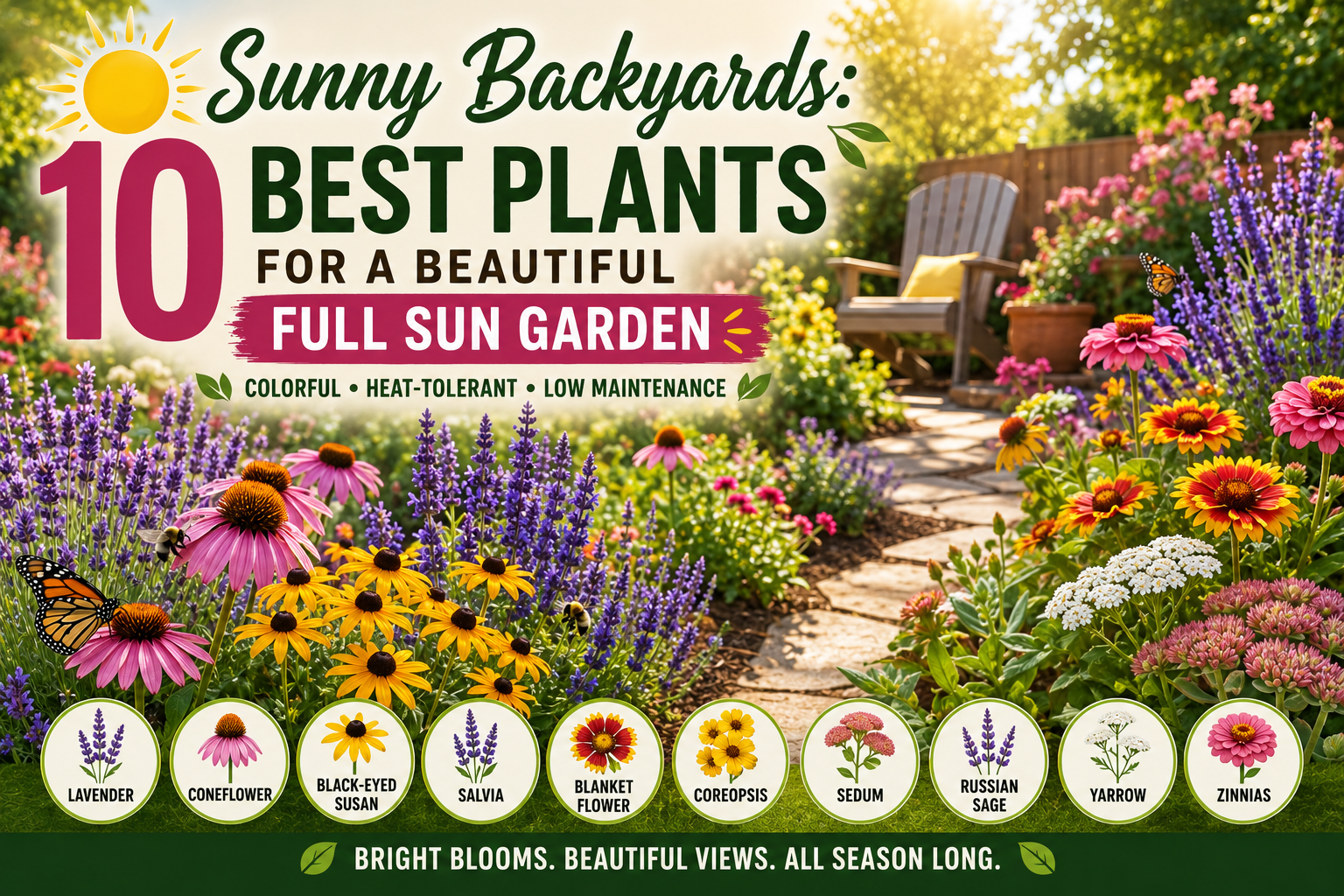
If your backyard receives six or more hours of direct sunlight each day, you have the perfect opportunity to grow a wide variety of beautiful and hardy plants. Sunny Backyards provide the ideal environment for colorful flowers, fragrant herbs, and drought-tolerant plants that thrive in bright conditions. However, choosing the right plants is essential to ensure your garden remains healthy, vibrant, and easy to maintain.
Many sun-loving plants not only produce stunning blooms but also attract beneficial pollinators like bees, butterflies, and hummingbirds. They can transform an ordinary backyard into a lively outdoor space filled with color and natural beauty throughout the growing season. In addition, many of these plants require less water once established, making them an excellent choice for gardeners looking to conserve water and reduce maintenance.
In this guide, you’ll discover the best plants for Sunny Backyards, learn what to consider before planting, and explore easy-to-grow options that are suitable for beginners and experienced gardeners alike. Whether you’re creating flower beds, borders, or a pollinator-friendly garden, these plants will help you build a beautiful landscape that flourishes under the sun.
Why Choosing the Right Plants for Sunny Backyards Matters
Not every plant can tolerate long hours of direct sunlight. While some species flourish in full sun, others may wilt, scorch, or struggle to grow. Selecting plants that naturally thrive in Sunny Backyards helps create a healthier, more attractive garden with less effort.
Here are some key benefits of choosing sun-loving plants.
Better Plant Growth
Plants that enjoy full sunlight produce stronger stems, healthier leaves, and more abundant flowers. They use sunlight efficiently to create energy through photosynthesis, resulting in vigorous growth.
More Colorful Blooms
Many flowering plants produce brighter, longer-lasting blooms when they receive enough sunlight. A sunny backyard filled with colorful flowers creates a welcoming and eye-catching outdoor space.
Lower Water Needs
Many full-sun plants become drought-tolerant once established. As a result, they require less frequent watering than moisture-loving shade plants, helping you save both time and water.
Attracts Pollinators
Flowers that thrive in Sunny Backyards often attract bees, butterflies, hummingbirds, and other beneficial pollinators. These visitors help improve pollination, leading to healthier flowers, fruits, and vegetables.
Easier Maintenance
Plants suited to full sun generally experience fewer problems related to poor growth caused by insufficient light. With proper care, they remain healthier and require less maintenance over time.
Creates a Beautiful Outdoor Space
A well-planned sunny garden can enhance your home’s curb appeal and provide a relaxing place to spend time outdoors. Combining plants with different colors, heights, and blooming periods keeps your backyard attractive throughout the season.
Factors to Consider Before Choosing Plants
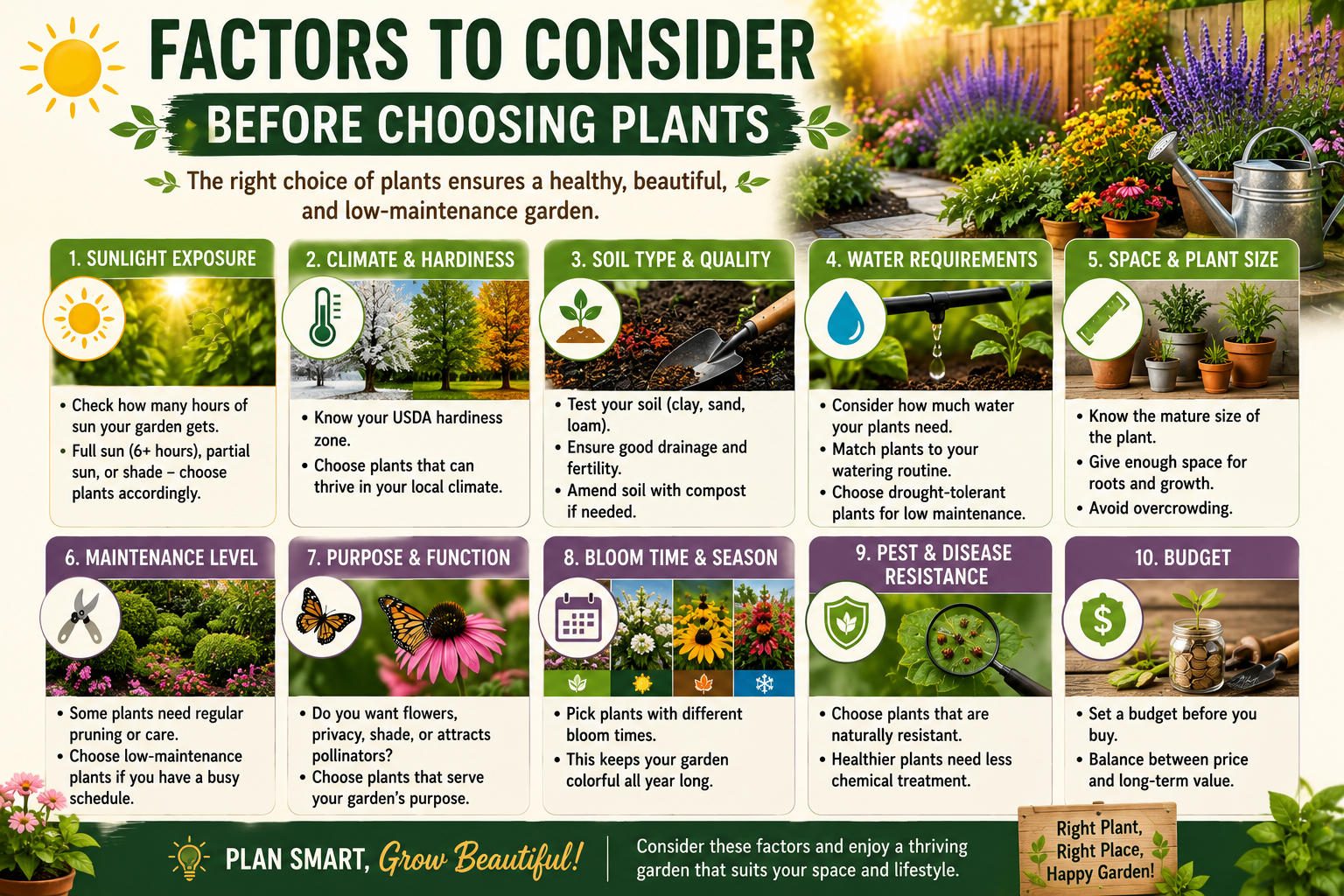
Before selecting plants for your Sunny Backyards, it’s important to understand your garden’s growing conditions. Choosing plants that match your environment will increase their chances of thriving.
Sunlight Duration
Most full-sun plants need at least six to eight hours of direct sunlight each day. Observe your backyard to determine which areas receive the most sunlight before planting.
Soil Type
Healthy soil is the foundation of a successful garden. Check whether your soil is sandy, clay-based, or loamy, and improve it with compost if necessary to enhance drainage and fertility.
Climate
Choose plants that are well suited to your local climate. Some varieties tolerate extreme heat, while others perform better in regions with mild summers.
Water Requirements
Although many sun-loving plants are drought-tolerant, newly planted flowers still need regular watering until their roots become established.
Available Space
Consider how large each plant will grow. Give plants enough room to spread naturally, allowing good air circulation and reducing the risk of disease.
H3: Tips for Choosing the Best Plants
- Select plants labeled for full sun.
- Mix annuals and perennials for year-round interest.
- Include native plants whenever possible.
- Group plants with similar watering needs.
- Choose a variety of bloom times for continuous color.
- Add plants of different heights for visual appeal.
Planning carefully before planting will help your Sunny Backyards remain healthy, colorful, and easy to care for throughout the year.
Plant #1 – Lavender
Lavender is one of the best choices for Sunny Backyards because it thrives in hot, dry conditions and fills the garden with beautiful purple flowers and a relaxing fragrance. It is also highly attractive to bees and butterflies, making it an excellent addition to pollinator-friendly landscapes.
Once established, lavender requires minimal watering and very little maintenance, making it perfect for beginner gardeners.
Growing Requirements
- Full sun (6–8 hours daily)
- Well-drained soil
- Moderate watering until established
- Good air circulation
Why Choose Lavender?
- Beautiful purple blooms
- Pleasant fragrance
- Drought tolerant
- Attracts pollinators
- Low maintenance
With regular pruning after flowering, lavender remains compact and continues producing blooms year after year.
Plant #2 – Coneflower (Echinacea)
Coneflower is a hardy perennial that performs exceptionally well in Sunny Backyards. Known for its large daisy-like flowers in shades of purple, pink, white, and orange, it adds long-lasting color from summer into early autumn.
This resilient plant tolerates heat, drought, and poor soil while attracting butterflies and bees.
Growing Requirements
- Full sun
- Well-drained soil
- Moderate watering
- Occasional deadheading
Why Choose Coneflower?
- Long blooming season
- Heat and drought tolerant
- Attracts butterflies and bees
- Excellent cut flower
- Easy to grow
Leaving seed heads on the plants after blooming also provides food for birds during autumn and winter.
Plant #3 – Black-Eyed Susan
Black-Eyed Susan is a cheerful flowering perennial that brightens Sunny Backyards with its golden-yellow petals and dark centers. Its long blooming period and easy care make it a favorite among home gardeners.
These flowers bloom throughout summer and continue adding vibrant color into early fall.
Growing Requirements
- Full sunlight
- Well-drained soil
- Moderate watering
- Occasional removal of faded flowers
Why Choose Black-Eyed Susan?
- Bright yellow blooms
- Long flowering season
- Drought tolerant
- Attracts bees and butterflies
- Low-maintenance perennial
Black-Eyed Susan pairs beautifully with ornamental grasses, lavender, and coneflowers to create colorful, natural-looking garden borders.
Comparison Table: Best Plants for Sunny Backyards
| Plant | Sunlight Needs | Water Needs | Bloom Season | Maintenance Level | Pollinator Friendly |
|---|---|---|---|---|---|
| Lavender | Full Sun | Low | Late Spring to Summer | Low | ⭐⭐⭐⭐⭐ |
| Coneflower (Echinacea) | Full Sun | Low to Moderate | Summer to Early Fall | Low | ⭐⭐⭐⭐⭐ |
| Black-Eyed Susan | Full Sun | Moderate | Summer to Fall | Low | ⭐⭐⭐⭐☆ |
Plant #4 – Salvia
Salvia is a colorful flowering perennial known for its tall spikes of purple, blue, pink, or red flowers. It performs exceptionally well in Sunny Backyards because it loves warm weather and blooms for a long period.
The nectar-rich flowers attract bees, butterflies, and hummingbirds, making salvia an excellent addition to pollinator-friendly gardens.
Why It’s Ideal for Sunny Backyards
- Thrives in hot, sunny locations
- Produces long-lasting blooms
- Attracts pollinators
- Drought tolerant once established
Growing Requirements
- Full sun (6–8 hours daily)
- Well-drained soil
- Good air circulation
Water Needs
Water regularly after planting. Once established, salvia only needs occasional watering during extended dry periods.
Blooming Season
Late spring through early autumn.
Maintenance Tips
- Remove faded flower spikes to encourage more blooms.
- Cut plants back after flowering to maintain a tidy appearance.
- Divide mature plants every few years for healthier growth.
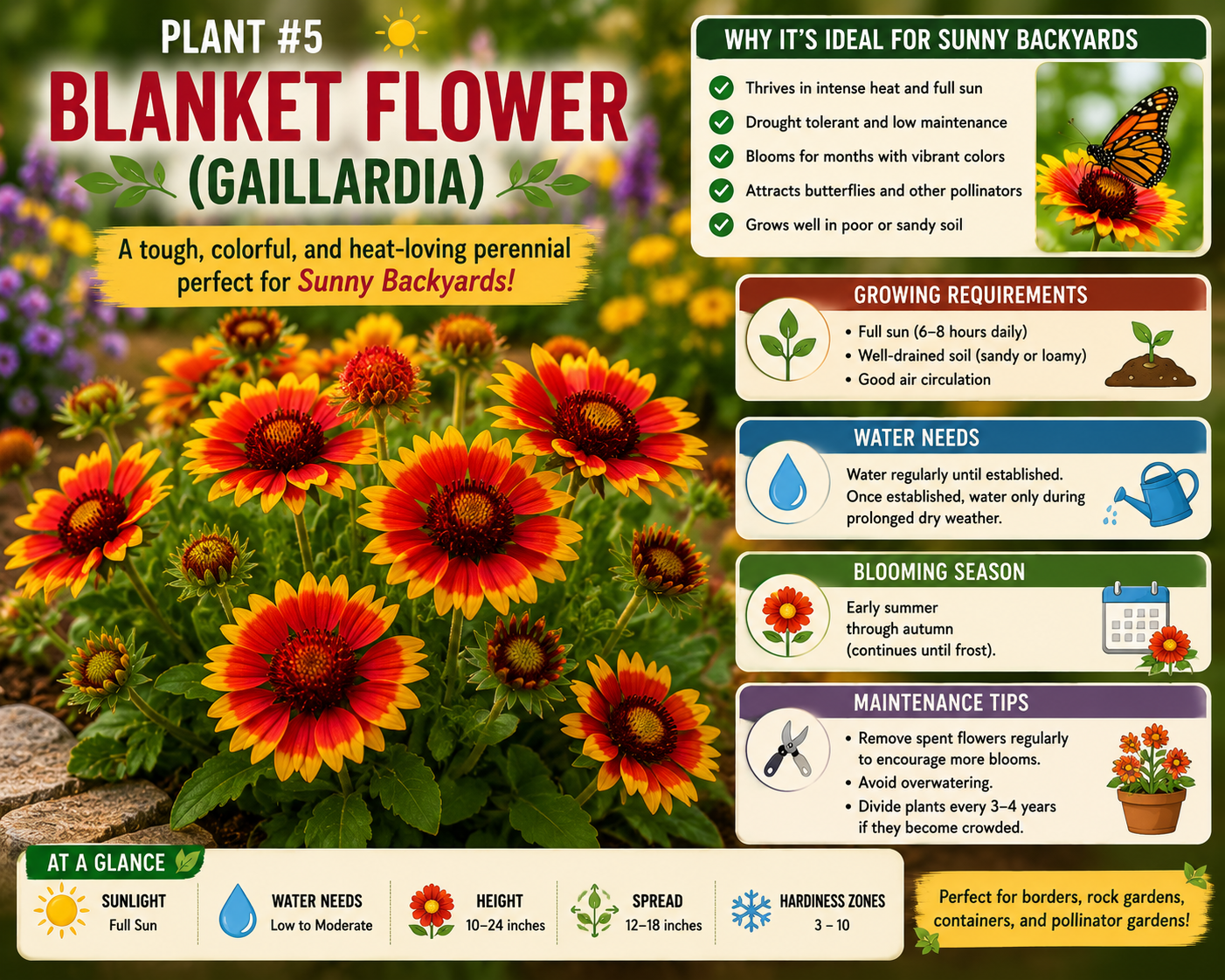
Plant #5 – Blanket Flower (Gaillardia)
Blanket Flower is a cheerful perennial with vibrant red, orange, and yellow blooms that resemble miniature sunsets. It is one of the toughest plants for Sunny Backyards, thriving in heat and poor soil.
Its long blooming season ensures continuous color from early summer until frost.
Why It’s Ideal for Sunny Backyards
- Loves intense sunlight
- Tolerates drought
- Produces colorful flowers for months
- Attracts butterflies
Growing Requirements
- Full sun
- Well-drained soil
- Moderate spacing for airflow
Water Needs
Water regularly until established, then only during prolonged dry weather.
Blooming Season
Early summer through autumn.
Maintenance Tips
- Remove spent flowers regularly.
- Avoid overwatering.
- Divide plants every three to four years if they become crowded.
Plant #6 – Coreopsis
Coreopsis, often called tickseed, is a reliable perennial that fills Sunny Backyards with bright yellow, pink, orange, or red flowers. It blooms generously throughout the summer and is easy for beginners to grow.
Its compact growth habit makes it ideal for flower beds, borders, and container gardens.
Why It’s Ideal for Sunny Backyards
- Long flowering season
- Heat tolerant
- Easy to grow
- Excellent for pollinator gardens
Growing Requirements
- Full sunlight
- Well-drained soil
- Moderate fertility
Water Needs
Water consistently during the first growing season. Mature plants tolerate short periods of drought.
Blooming Season
Late spring through late summer.
Maintenance Tips
- Deadhead faded flowers to encourage continuous blooming.
- Trim plants lightly if they become leggy.
- Divide every few years to maintain vigorous growth.
Plant #7 – Sedum (Stonecrop)
Sedum is a hardy succulent that performs exceptionally well in Sunny Backyards. Its thick, fleshy leaves store water, making it one of the most drought-tolerant garden plants available.
Sedum produces clusters of pink, red, or white flowers that attract bees and butterflies late in the growing season.
Why It’s Ideal for Sunny Backyards
- Extremely drought tolerant
- Requires very little maintenance
- Adds texture to garden beds
- Excellent for rock gardens
Growing Requirements
- Full sun
- Sandy or well-drained soil
- Good drainage
Water Needs
Minimal. Water only during long dry spells after plants become established.
Blooming Season
Late summer through autumn.
Maintenance Tips
- Avoid planting in poorly drained soil.
- Remove dead stems in early spring.
- Divide mature plants every four to five years.
Plant #8 – Russian Sage
Russian Sage is a stunning perennial with silvery foliage and delicate lavender-blue flowers. It thrives in Sunny Backyards where it receives plenty of direct sunlight and excellent drainage.
Its airy appearance adds movement and texture to flower beds throughout summer.
Why It’s Ideal for Sunny Backyards
- Handles extreme heat
- Drought tolerant
- Long blooming season
- Deer and rabbit resistant
Growing Requirements
- Full sun
- Well-drained soil
- Open growing space
Water Needs
Water moderately while establishing. Mature plants require very little supplemental watering.
Blooming Season
Mid-summer through early autumn.
Maintenance Tips
- Cut plants back in early spring.
- Avoid overly rich soil, which can reduce flowering.
- Prune lightly to maintain shape.
Plant #9 – Yarrow
Yarrow is a hardy perennial valued for its flat clusters of flowers and fern-like foliage. It grows exceptionally well in Sunny Backyards and is available in shades of yellow, white, pink, red, and orange.
Its flowers attract beneficial insects while also making excellent cut and dried arrangements.
Why It’s Ideal for Sunny Backyards
- Heat and drought resistant
- Attracts butterflies and bees
- Long-lasting blooms
- Suitable for low-maintenance gardens
Growing Requirements
- Full sunlight
- Well-drained soil
- Moderate spacing
Water Needs
Water occasionally after establishment. Too much moisture can reduce plant health.
Blooming Season
Late spring through late summer.
Maintenance Tips
- Deadhead flowers to encourage additional blooms.
- Divide clumps every three to four years.
- Avoid excessive fertilizer.
Plant #10 – Zinnias
Zinnias are among the easiest annual flowers to grow in Sunny Backyards. They produce vibrant blooms in nearly every color and flower continuously throughout the summer until the first frost.
Because they grow quickly from seed, zinnias are a favorite choice for beginner gardeners.
Why It’s Ideal for Sunny Backyards
- Fast-growing
- Bright, colorful flowers
- Excellent cut flowers
- Attracts butterflies
Growing Requirements
- Full sun
- Well-drained, fertile soil
- Good air circulation
Water Needs
Water deeply once or twice a week, depending on rainfall. Keep foliage as dry as possible to reduce disease.
Blooming Season
Early summer until frost.
Maintenance Tips
- Remove faded flowers regularly.
- Water at the base of the plant.
- Plant new seeds each spring for continuous seasonal color.
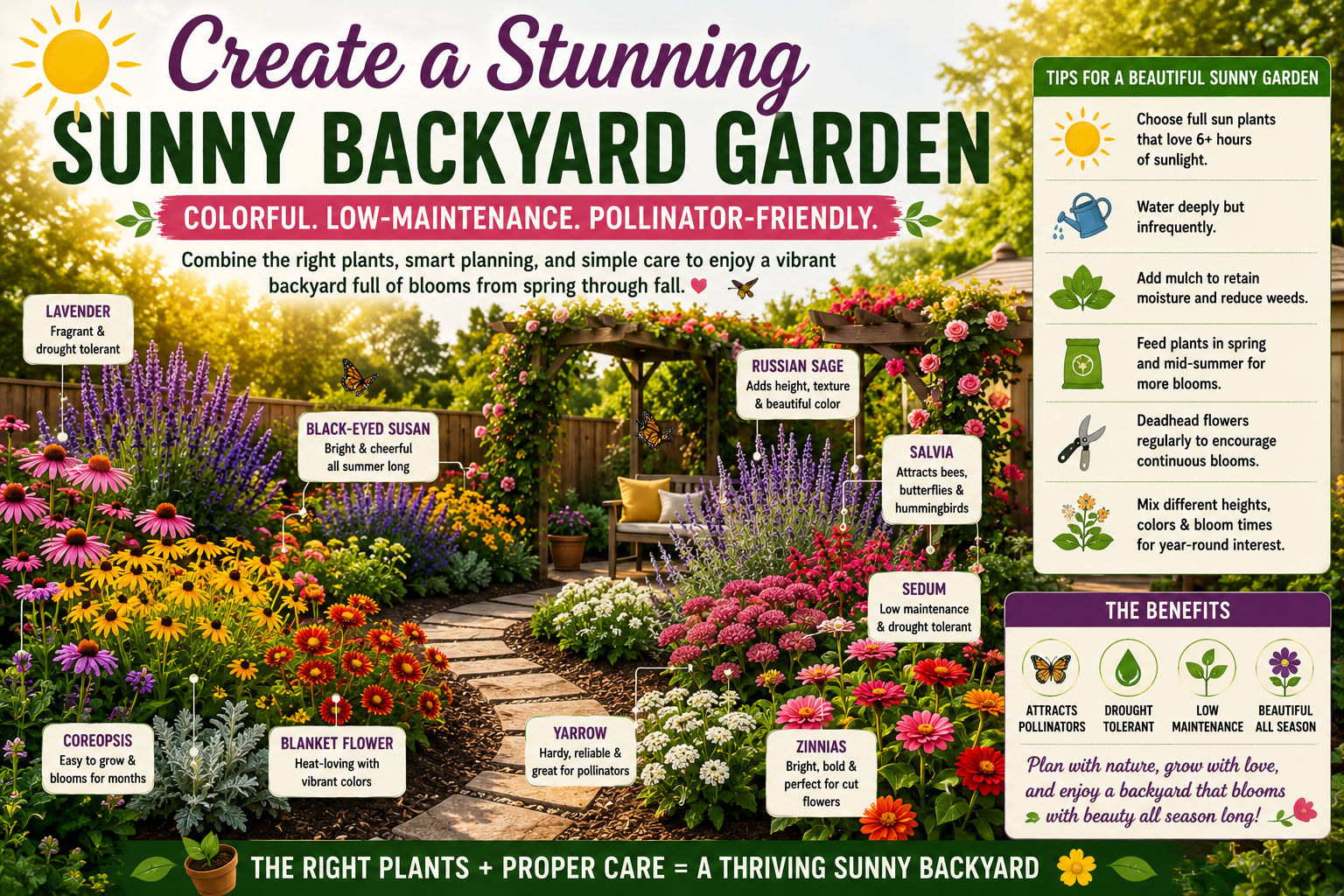
Create a Stunning Sunny Backyard Garden
These seven plants, combined with lavender, coneflowers, and Black-Eyed Susans from Part 1, provide a wonderful mix of colors, textures, and bloom times for Sunny Backyards. Most are drought tolerant, attract beneficial pollinators, and require only basic care once established.
How to Care for Plants in Sunny Backyards
Growing beautiful plants in Sunny Backyards is rewarding, but proper care is essential to keep them healthy throughout the year. Although many sun-loving plants are heat and drought tolerant, they still need the right balance of water, nutrients, and maintenance to perform their best.
By following a few simple gardening practices, you can enjoy vibrant flowers, healthy foliage, and a colorful backyard season after season.
Water Deeply but Less Frequently
Most plants in Sunny Backyards prefer deep watering rather than frequent light watering. Deep watering encourages roots to grow farther into the soil, making plants stronger and more drought-resistant.
Water early in the morning whenever possible. This allows moisture to soak into the soil before the heat of the day causes excessive evaporation.
Watering Tips
- Water at the base of the plant.
- Avoid wetting the leaves.
- Check soil moisture before watering.
- Increase watering during prolonged heat waves.
- Use a soaker hose or drip irrigation for efficient watering.
Apply Mulch Around Plants
Mulch is one of the best ways to protect plants growing in Sunny Backyards. It helps retain soil moisture, suppresses weeds, and keeps the soil cooler during hot summer days.
Organic mulches such as shredded bark, straw, wood chips, or compost also improve soil quality as they decompose.
Feed Plants with Balanced Fertilizer
Flowering plants need nutrients to produce healthy blooms throughout the growing season.
Use a balanced, slow-release fertilizer or organic compost in spring and again during the growing season if needed. Avoid overfertilizing, as too much nitrogen can encourage leafy growth instead of flowers.
Remove Spent Flowers
Deadheading, or removing faded flowers, encourages many plants to produce more blooms instead of using energy to produce seeds.
Plants like zinnias, coreopsis, blanket flowers, and salvia benefit greatly from regular deadheading.
Prune When Necessary
Pruning keeps plants healthy and improves air circulation.
Remove:
- Dead branches
- Damaged stems
- Diseased leaves
- Overgrown growth
Regular pruning also helps maintain an attractive shape and encourages vigorous new growth.
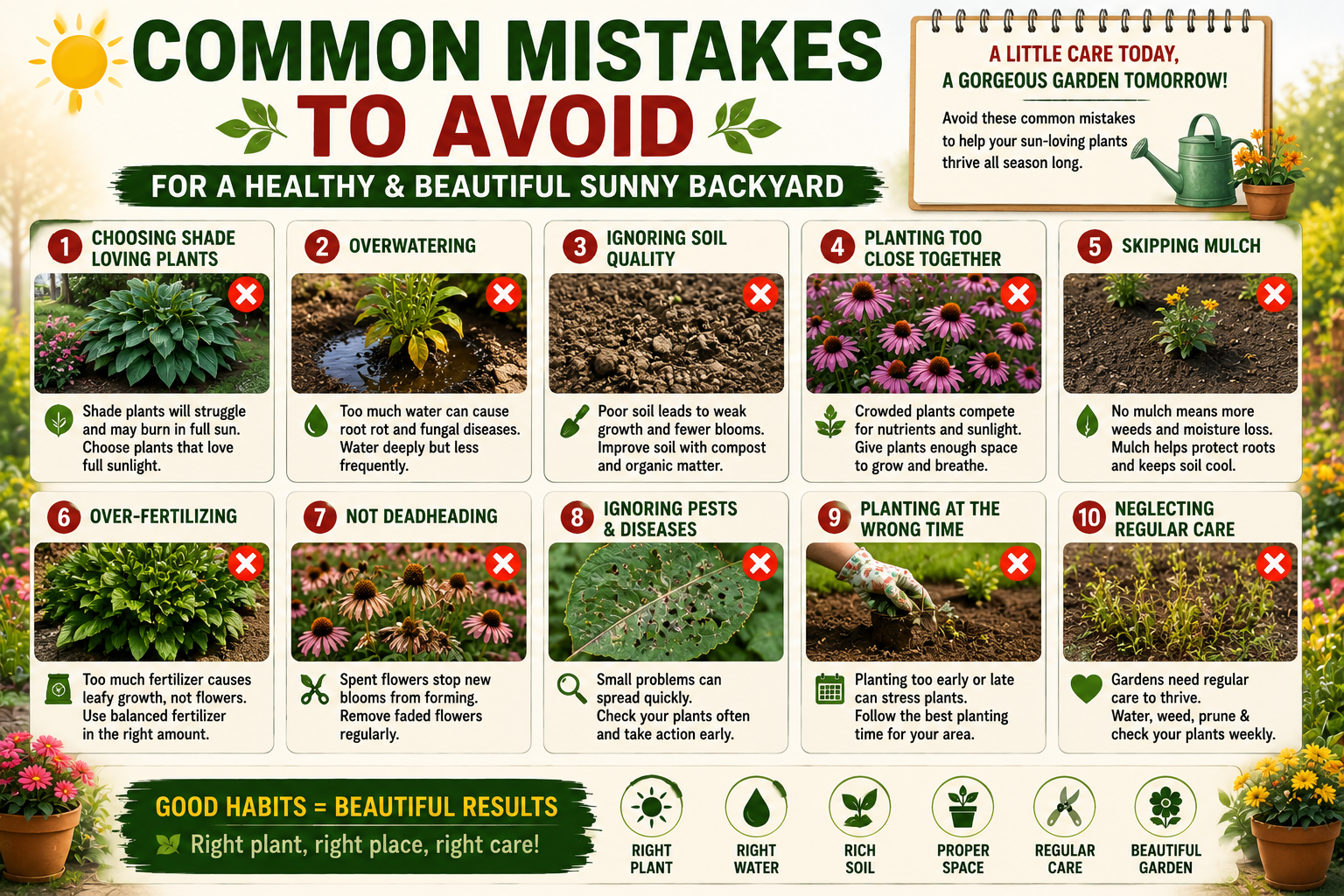
Common Mistakes to Avoid
Even experienced gardeners occasionally make mistakes that reduce the beauty of their Sunny Backyards. Fortunately, most problems are easy to prevent.
Choosing Shade-Loving Plants
Plants that require shade often struggle in direct sunlight. Their leaves may scorch, wilt, or turn brown.
Always read plant labels carefully and choose varieties recommended for full sun.
Overwatering
Many sun-loving plants prefer slightly dry soil between watering.
Constantly wet soil can cause:
- Root rot
- Yellow leaves
- Fungal diseases
- Poor flowering
Allow the top layer of soil to dry slightly before watering again.
Ignoring Soil Quality
Even the best plants perform poorly in unhealthy soil.
Improve your soil by adding:
- Compost
- Organic matter
- Well-rotted manure
Healthy soil supports stronger roots and healthier plants.
Planting Too Close Together
Crowded plants compete for sunlight, water, and nutrients.
Proper spacing provides:
- Better airflow
- Reduced disease risk
- Stronger growth
- Easier maintenance
Always follow the spacing recommendations on plant labels.
Skipping Regular Maintenance
Weeding, pruning, watering, and removing faded flowers may seem like small tasks, but they make a significant difference.
Spending just a few minutes each week maintaining your Sunny Backyards keeps plants looking their best.
Seasonal Care Tips
Different seasons bring different gardening needs. Following a seasonal care routine helps your Sunny Backyards stay healthy all year.
Spring
It is the perfect time to prepare your garden for a successful growing season.
Spring Checklist
- Clean garden beds.
- Add compost to improve soil.
- Apply fresh mulch.
- Plant new flowers.
- Fertilize established plants.
Summer
Hot weather requires extra attention.
Summer Checklist
- Water deeply during dry periods.
- Remove faded flowers.
- Watch for pests and diseases.
- Pull weeds regularly.
- Support taller flowering plants if needed.
Autumn
As temperatures cool, prepare plants for winter.
Autumn Checklist
- Cut back dead stems.
- Divide overcrowded perennials.
- Plant spring-flowering bulbs.
- Refresh mulch.
- Clean fallen leaves from garden beds.
Winter
Although many plants become dormant, winter is an excellent time for planning.
Winter Checklist
- Protect sensitive plants from frost.
- Sharpen and clean gardening tools.
- Plan next season’s garden layout.
- Order seeds and plants.
- Review your watering system.
Following these seasonal tasks helps ensure your Sunny Backyards remain colorful and healthy year after year.
Conclusion
Creating beautiful Sunny Backyards starts with choosing plants that thrive in full sunlight and providing them with the care they need to flourish. From fragrant lavender and colorful coneflowers to vibrant zinnias and hardy sedum, sun-loving plants can transform your outdoor space into a lively, low-maintenance garden filled with blooms throughout the growing season.
Regular watering, mulching, pruning, and seasonal maintenance all contribute to healthier plants and longer-lasting flowers. In addition, selecting drought-tolerant varieties helps conserve water while making your garden easier to care for during hot weather.
Remember that every backyard is unique. Take time to observe how much sunlight different areas receive, improve your soil with organic matter, and group plants with similar water needs. By combining thoughtful planning with consistent care, you can create Sunny Backyards that are both beautiful and inviting.
Whether you’re planting a colorful flower border, designing a pollinator-friendly landscape, or simply adding a few low-maintenance favorites, the right plants will reward you with vibrant blooms, healthy growth, and lasting enjoyment for years to come.
Frequently Asked Questions (FAQs)
1. What plants grow best in sunny backyards?
Some of the best plants for Sunny Backyards include lavender, coneflowers, Black-Eyed Susans, salvia, blanket flowers, coreopsis, sedum, Russian sage, yarrow, and zinnias.
2. How much sunlight do full-sun plants need?
Most full-sun plants require at least 6 to 8 hours of direct sunlight each day to grow well and produce abundant flowers.
3. How often should I water plants in sunny backyards?
Water deeply one or two times per week, depending on rainfall, soil type, and temperature. Newly planted flowers may need more frequent watering until they become established.
4. Which plants for sunny backyards are drought tolerant?
Lavender, sedum, Russian sage, yarrow, blanket flower, and coneflower are excellent drought-tolerant choices once established.
5. How can I keep my sunny backyard colorful all season?
Choose plants with different bloom times, remove faded flowers regularly, apply mulch, fertilize when needed, and water consistently during dry weather to enjoy continuous color.
6. Are sunny backyard plants good for pollinators?
Yes. Many sun-loving plants, including lavender, salvia, coneflowers, yarrow, and zinnias, attract bees, butterflies, and hummingbirds, helping support a healthy garden ecosystem.
7. Can I grow vegetables in sunny backyards?
Absolutely. Many vegetables, including tomatoes, peppers, cucumbers, squash, beans, and herbs like basil and rosemary, thrive in Sunny Backyards with plenty of direct sunlight.
You can also check our article Garden Pests: 10 Natural Ways to Get Rid of Them